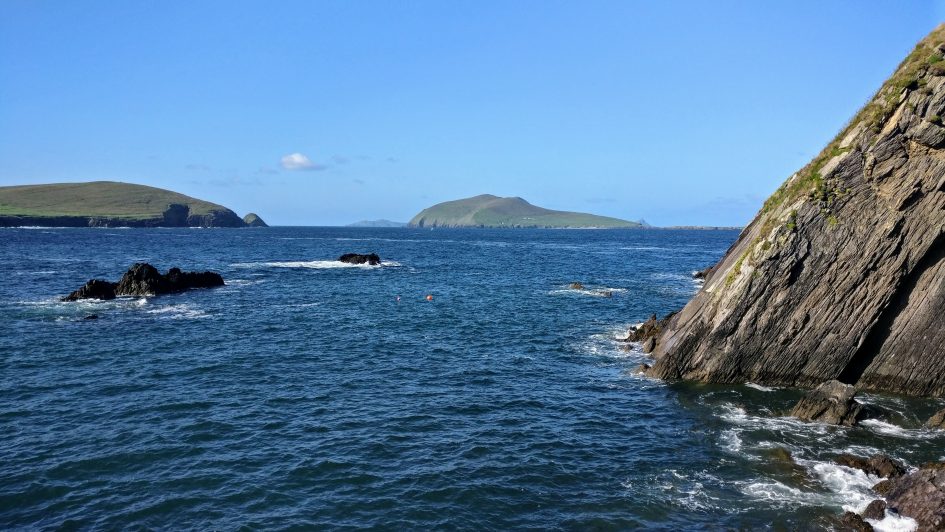
In a previous blog article, I wrote about my trip to Ireland. While I enjoyed the entire trip, there was one place that left a lasting impact on me. Before the trip, I did not know this place existed. Now I cannot get the place or its story out of my mind.
The place is Great Blasket Island just off the Irish coast near the Dingle Peninsula. There have been people living on Great Blasket Island for centuries. The history we will explore took place in the 19th and 20th century. At the height of its population, 180 people lived on Great Blasket Island. The isolation from the main Irish island made life on Great Blasket Island unique.
The folks living on Great Blasket Island were farmers and fishermen. They consumed most of their production and sold the rest on the main Irish island. Because of their remote location and need to constantly farm and fish, educational opportunities were limited. There was never any electricity or indoor plumbing installed on the island. The residents lived an isolated, primitive but happy life.
At the dawning of the 20th century, islands residents became more aware of life on the mainland. Specifically, they became aware of the opportunity of immigration to America. Young islanders began to move to the United States in search of new opportunities. The Islanders were dependent on being able to row across the sometimes-rough sea to the mainland, so they could trade and buy essential goods. With so many young people departing for America, it became increasingly difficult to make the mainland journey. With the increasing difficulty of living on Great Blasket Island, a decision was reached in 1953 to abandon life on the island. The entire population moved to the mainland, and Great Blasket Island remains abandoned today.
One of the fascinating events to come out of life on an isolated island is the number of published authors who were born and reared in this environment. There were 41 published authors from Great Blasket Island. This is an amazing number of authors considering the limited educational opportunities and life experiences. Most of the folks wrote about their fascinating life of isolation and survival. One of the most famous of the authors was Tomàs O’Crohan.
I just finished reading one of Tomàs O’Crohan’s books called “The Islandman: The Hidden Life of Tomàs O’Crohan.” This entertaining narrative provides deep insight into how people lived on Great Blasket Island in the late 19th and early 20th centuries. Tomàs was a typical Great Blasket Island resident who lived a tough life merely trying to survive. Tomàs spent most of his time farming, fishing or cutting turf for warmth. There are a few descriptions of social activities such as singing and dancing with neighbors, but these were scarce. Despite being thoughtful and highly intelligent, Tomàs only receive a limited education. While the Island did have an occasional school teacher, most either left to get married or died. From reading his book, it is easy to tell that Tomàs was a thinker and a doer, always possessing a positive outlook. I think I would have liked Tomàs; perhaps we could have been friends. Alas, Tomàs died 30 years before I was born. Tomàs married and had a large family of 10 children. Due to the harsh living conditions and limited medical facilities, death was a frequent visitor to the Great Blasket Islands. At the end of the book, in the year 1926, Tomàs’ wife had died, and he was down to 2 children left alive. Most of these deaths were due to measles, whooping cough, and accidents. One of Tomàs children lived on the Irish mainland and the other in America. Sadly, as he approached old age, Tomàs was alone. Still, even in this lonely state, he had a positive, move forward attitude.
On rare occasions, a book makes a lasting impact on me. Tomàs O’Crohan’s book has made such an impact. He is a terrific writer with his descriptions of Island life making the reader feel present during these difficult days. As mentioned earlier, I like Tomàs and believe the degrees of separation between us are small. Tomàs was simply born at a different place and time; he would have been very successful today. As members of an affluent society, it is good to read accounts of capable people who struggled to survive during difficult times.
These are the key themes from “The Islandman: The Hidden Life of Tomàs O’Crohan.”
- Hard work is a virtue and at times necessary to survive for another day.
- No matter what the circumstances, optimism is good for the soul.
- Tragedy and heartache seem to be an element of the human condition.
- Loneliness is devastating to the human spirit.
- In any setting, at any point in history, character and integrity are essential attributes to living a successful and honorable life.
If you are still reading this blog entry, I appreciate your diligence is this was a bit of an indulgence for me. If you are interested in learning about life on a remote island for 100 years ago, I highly recommend “The Islandman: The Hidden Life of Tomàs O’Crohan.” My lingering thoughts after reading this book are, be grateful for the things we have and our easy life and most of all, be thankful for family and friends.
October 15, 2018 at 9:08 pm
We are traceling in Amish country and I see and feel as you are describing. We are blessed but at the same time the simple life seems enticing.
November 10, 2018 at 2:47 pm
The observation “loneliness is devastating to the human spirit” should remind us all to reach out to those in the church without family or spousal support.