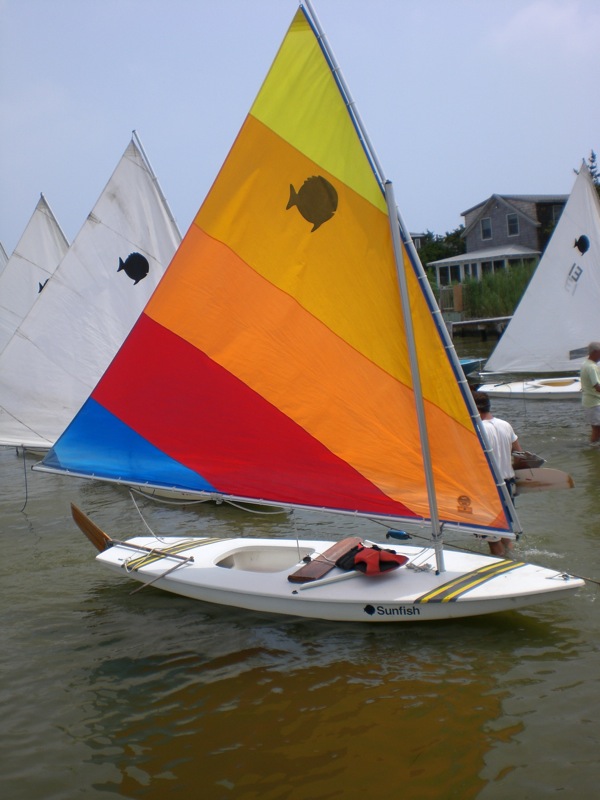
I have always liked the idea of sailing on a boat. The picture of me traveling over water with the wind as the source of power is peaceful and invigorating. There are technical aspects of sailing I also find interesting. Many years ago, when I was in my early 20s, my best friend and I decided to learn to sail. Without any experience or knowledge, we purchased a Sunfish sailboat. It was all we could do to split the cost of the boat, we could not afford a trailer. The sunfish was small enough that I could transport it in my pickup truck.
Since neither of us had any concept on how to sail our new boat, I decided to read a book on sailing and then head for Lake Houston. I thought about taking lessons, but a lack of funds prohibited this obvious next step. After reading my book, I thought I had a grasp on the basics of sailing. I practiced some of the maneuvers with the boat sitting in my parent’s yard. What could possibly go wrong?
The day arrived when we were launching our sailboat on its maiden voyage. We drove to Lake Houston. I am not sure why we picked Lake Houston, probably because it was close. We arrived at our destination and put our boat in the water. Since I had read the book on sailing, I was designated the captain for the initial voyage. After setting the mast, rudder, and centerboard, I was ready to go. I noted the wind direction, jumped on the boat and set my sails, just like in the book. The sail caught the wind and the boat picked up speed. I was sailing! Who needs expensive lessons? From my seasoned perspective of today, I can’t believe I did this. I was not even wearing a life jacket. There is much less to worry about when you are young.
I quickly realized I knew the theory of turning the boat, but not the practicality of turning (tacking). I remember thinking, “I wish I had brought my book with me so I could review the chapter on turning.” It really did not seem to be a problem as the lake was big and I was enjoying the sensation of sailing. So, I just keep on sailing with no concern regarding how I would return to my starting point. There is nothing quite like living for the moment.
The subject of lake navigation was not covered in my sailing book. I noticed I was passing a line of buoys, but had no idea what this meant. I learned later the buoys meant, “no boating past this point.” I realized I was now getting closer to a strip of land that seemed to be several feet higher than the lake. As I got closer I had an epiphany that I was sailing towards the dam. At this point in my life, I didn’t really know how lake dams were structured. My immediate thought was, I am going to go over the dam and die. The only dam I had in my mind was Hoover Dam and I imagined my long fall to the river below. Of course, this is not the case with the Lake Houston dam and beyond breaking lake rules, I was really not in any danger. I did not know this reassuring fact and begin to panic. I concluded that I needed to turn this boat around. I knew from my “deep research” on sailing that if I just let go of the sheet (rope), the boat would turn into the wind and stop. I proceeded to release the sheet and the boat did indeed behave as expected. Even though I was stopped, the boat was still not pointing in the correct direction for me to travel back the way I came. I decided to go with the brute force method. I jumped in the lake, remember I was not wearing a life jacket, and turned the boat by swimming and pushing the bow to the proper heading. I then jumped back on the boat and set my sail to return to the legal portion of the lake and eventually to my starting point. Ultimately, through trial and error, I learned how to properly steer a boat. In order to safely learn to manage a sailboat, I needed hands-on instruction. While reading about sailing was helpful, it did nothing but instill a false confidence, making me a dangerous sailor. I am a voracious reader. I have learned many things through reading. I received college degrees, mostly through reading. While reading is an essential element in learning a skill, to master the skill you must use other senses to complete the learning process.
I have many thoughts about the college education system in the United States. Depending on the major selected, the value of a college degree varies widely. Accumulating debt for a degree that results in limited job opportunities can be a multi-decade, catastrophic financial decision. The idea that most people need to attend college, no matter what major is selected, is misguided. Financially and academically, college is not for everyone. As a nation, we should encourage trade schools and other ways of earning a living as options to help enable our young folks to be more successful in making the transition to adults.
Even is college is part of your future and includes a viable major, I strongly encourage working as an intern. Working as an intern in your chosen field is a powerful learning experience. First, you get real-world experience to help you decide if your major is leading you down the correct path. Second, you obtain hands-on experience to help augment book learning. I was an intern for 2 years while attending college. This internship did more than any class to help direct my energy towards an area of interest and gainful employment.
While working in the corporate world, our best long-term employees came through the intern program. While it might be tempting to take time off and rest during the summer, I highly recommend at least 2 years of working as an intern. Many times, the intern is hired by one of the companies where they worked. Just like my sailing example, add some real-world, hands-on experience to your book knowledge. Working as an intern is one of the best decisions you can make during your college career
Make the most of this day!
May 26, 2018 at 8:17 am
That is a great article. I personally do not learn well in a classroom setting and a college education would have been a waste of time for me. The hands on vocational courses I took were much more appropriate for me. This one made me laugh.
Joe