As mentioned in previous blogs, I am an airplane geek. I love visiting aircraft museums. I have been to the Lone Star Museum, Museum of Flight and National Air and Space Museum. I have heard for many years if I wanted to see a lot of cool airplanes, I should go to the National Museum of the United States Air Force. As part of my recent Mid America Tour, I planned to spend some time in Dayton, Ohio to visit this special place.
I allocated a full day to tour the Air Force Museum and was concerned I might have allocated too much time. I was wrong; I could have easily spent two days in this museum. The Museum resides in three huge hangers on the Wright-Patterson Air Force Base. The exhibits are separated by time-frame so you can start the tour with a Wright Flyer and end seeing an F-22 Raptor.
Early airplanes were built using wood, wire, and cloth. Many of these airplanes didn’t have ailerons but used wing warping to control roll. These planes look flimsy, and the people who flew them were courageous. World War I saw the use of airplanes as weapons for the first time. The museum housed all the famous craft from World War I, including a Fokker Dr1 Dreidecker in which Manfred von Richthofen, the Red Baron, flew in to claim 80 aerial victories.
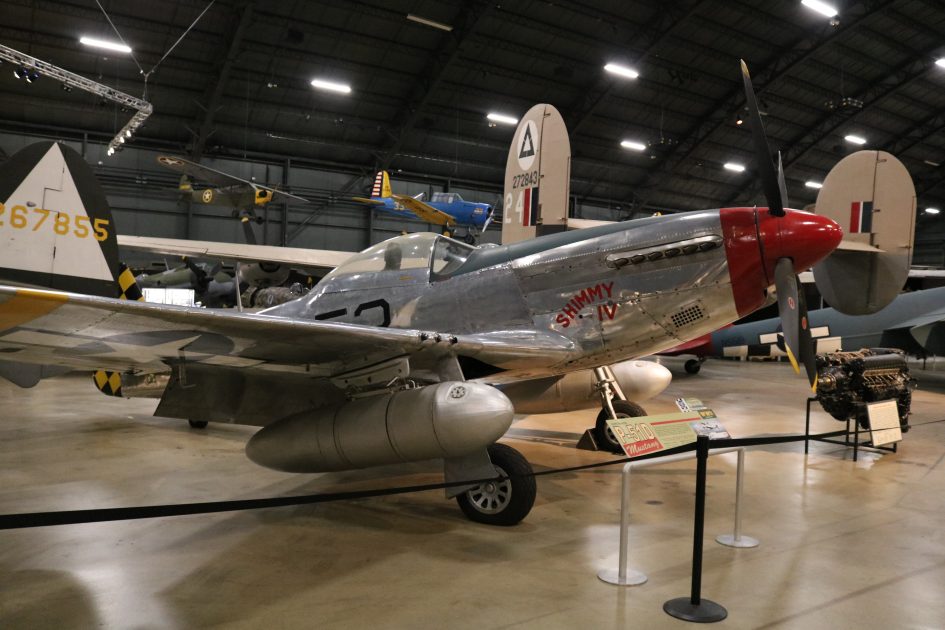
The transition to World War II airplanes was exciting as this era represents some of my favorite aircraft. Listed below are the World War II aircraft I saw for the first time at this museum
- P-51 Mustang
- ME-109
- Fokken-Wolfe 190
- ME-262
- Spitfire
- Mitsubishi A6M Zero
- F4U-Corsair
- B-25 Mitchell
- B-29 Superfortress
I was thrilled to encounter the real Memphis Belle. This aircraft was the famous B-17 that was the first to complete 25 missions and return to the USA. I have ridden in a B-17 called the Thunderbird, but this airplane never saw combat. The museum did a great job telling the story of this unique airplane.
I wrote a previous blog article about the Doolittle Raiders. This piece describes the story of their commemorative goblets. The museum had the full goblet collection along with the 1896 cognac. It was an honor to see the actual memento these heroes used to remember their brave event.
The next exhibit was the 1950s, the era of the Korean War and the dawning of the jet age. Prominent aircraft in this exhibit was the F-86 and MIG-15. During the war, there was a North Korean MIG-15 pilot who defected. The famous test pilot Chuck Yeager was called upon to test the Russian made airplane. The museum has the actual MIG-15 on display.
Moving on to the Vietnam era added a few more exciting favorites. The F4 was on display, and it really looks like a bus with big jets on it. They also had an F-105 Thunderchief or Thud. These bombers were constant targets of North Vietnamese SAMs. The pilots who flew these airplanes were very courageous. Dominating the hanger was a B-52 bomber. I have seen this airplane before but not up close. The B-52 is simply a massive aircraft possessing a considerable intimidation factor.
I was able to see a few other interesting aircraft.
- Sacred Cow – Franklin Roosevelt’s presidential airplane
- The Independence – Harry Truman’s presidential airplane
- Columbine – Dwight Eisenhower’s presidential airplane
- X-15 – hypersonic rocket aircraft that flew 4520 mph
- SR-71 Blackbird – long-range Mach 3+ reconnaissance aircraft
- F15-Eagle
- F16-Falcon
If you are mildly to not interested in airplanes, the Air Force Museum is still worth a bit of your time. If you like airplanes, this is as good as it gets. I spent 7 hours at this place and felt like I was only scratching the surface. Another great feature of this museum is that it is free. The volunteers scattered throughout the facility are another bonus; they know their airplanes and love talking about them. Let me know if you would like access to all my photographs.
Make the most of this day!
July 23, 2019 at 10:39 am
Alan,
I really enjoyed your article on Wright-Patt. I flew in there while I was in the USAF and enjoyed spending a few hours looking over these beautiful aircraft.
I enjoyed meeting a couple of nom-com’s at Wright-Patt who were incredibly talented wood workers. Their job, every day, was to spend time carving by hand exact models of the aircraft on display. It was amazing to see their work.
You mentioned seeing the Thud. One of my T-38 jet instructor pilots was a Thud pilot in Vietnam. His job was to seek out the enemy radar and defeat it so that other bombers coming behind him would not be harassed. One of their incredible achievements was to allow themselves to be targeted by SAM missile sites and have SAM’s coming right at them. They would head straight up, then do an abrupt 180 degree turn, heading straight back to earth. The SAM’s could not turn as fast, but when the did, the SAM’s were targeting the Thud’s, expecting to blow them out of the sky. But my instructor and his buddies would have their Thud’s pointed straight down, right at the SAM site that had targeted them – or another convenient military target. At the last moment, the Thud’s would do another 180, a full 9g turn, heading straight back up. The SAM on their tail, not being able to make that turn so quickly, would slam right into the missile site that it came out of, resulting in total destruction. Those Thud pilots had to be the bravest of the brave! Sadly, the North Vietnamese often located their SAM sites right next to hospitals and other civilian sites, so there was collateral damage. The US was blamed for this by Jane Fonda and other nuts, who never knew the collateral damage was done by the North Vietnamese missiles – not from US weapons.